
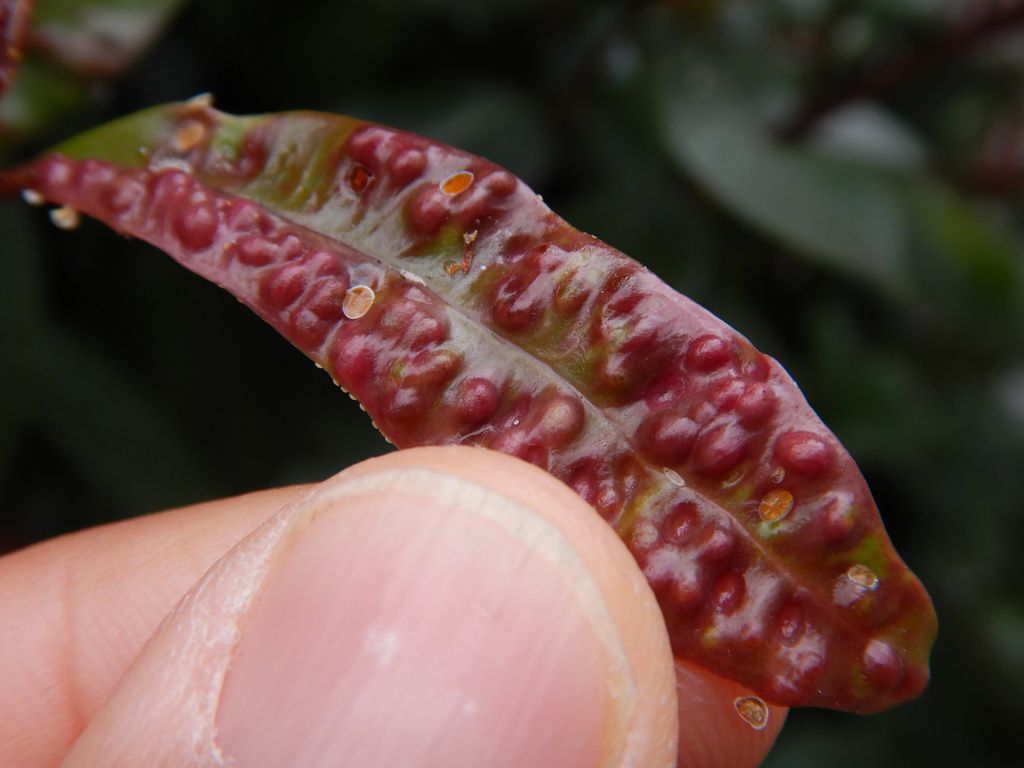
Short answer: pink, pimply, twisted new leaves are the work of the lilly pilly psyllid (Trioza adventicia, long misnamed Trioza eugeniae), a tiny sap-sucking insect. It's unsightly but it won't kill the plant. Trim off the damaged new growth (about 10–15 cm all round), bag it for the general waste bin, and keep the hedge watered so it isn't stressed. If you're planting a new hedge, choose a psyllid-resistant variety such as 'Resilience'.
Spring is when you notice it. Lilly pillies push out a flush of soft, coppery growth in October, and that's what the psyllid targets.
What you're looking at
The psyllid's young (nymphs) settle on the underside of soft new leaves. Each one sits in a small pit, which pushes up a pimple on the top of the leaf (Yates). A bad infestation leaves new growth crinkled, blistered and pinkish, and slows the hedge down, but the plant recovers (Gardening Australia).
Quick check:
- Bumps on top of the leaf, small pits underneath, only on newer leaves: that's psyllid.
- Yellow or orange powdery spots, distorted new shoots, dieback: that could be myrtle rust, a different and more serious fungal disease. See below.
How to fix an existing hedge
- Trim off the damaged growth. Gardening Australia suggests taking 10–15 cm off all round the plant. Yates says pruning off the worst of the damage helps prevent another generation.
- Bag it and bin it. Put trimmings in the general waste bin, not the compost or green-waste bin, so you're not moving the insects around.
- Keep the plant unstressed. Yates notes the psyllid takes hold most in unhealthy plants. Water deeply in dry spells.
- Check each new flush. The psyllid has several generations a year (Yates), so damage can come back on later growth. Trim again if it does.
- Treat sprays as a last resort. Systemic insecticides are sold for psyllid, but planting a resistant variety is the better long-term answer (Nurseries Online). The plant recovers on its own (Gardening Australia), so on most hedges trimming and good care are enough.
Trimming and spraying both have their place, but I start with good garden practice: check each new flush, remove infested growth, choose resistant plants and keep the hedge healthy. Spraying is the backup. If it's needed, use only a product registered and labelled for the job, and follow the label.
The lilly pillies that suffer most
Yates names the magenta lilly pilly (Syzygium paniculatum) and the weeping lilly pilly (Waterhousea floribunda) as the main hosts. The Australian Plants Society says the brush cherry (Syzygium australe) is heavily attacked too, although some of its cultivars were selected to resist it.
Psyllid-resistant choices (Sydney prices, checked 12 Oct 2026)
"Resistant" doesn't mean immune. It means the plant is much less likely to be attacked, and damage is milder when it happens (Nurseries Online).
| Variety | What it's like | Price |
|---|---|---|
| Syzygium australe 'Resilience' | The best-known psyllid-resistant hedge. Dense, with coppery-red new growth. | Sydney's Plant Market: 200 mm $15, 300 mm $65. The Australian Plant Shop: 140 mm $16 (sold out), 200 mm $34.60 (sale price), up to a 100 L plant about 2.2 m tall for $720 (sold out) |
| Syzygium australe 'Backyard Bliss' | A dense, narrow lilly pilly, about 3–4 m × 1–1.5 m unpruned (nursery figures). It's registered for plant breeder's rights as 'PC1', bred by Rob Tate at Pinecrest Nursery, Laurieton. In the breeder's PBR trial, psyllid damage was "absent or very weak", against "medium" on the comparison plant. That's a trial result, not a guarantee: Warners Nurseries lists it as susceptible to psyllid. Also used in pots. | Sydney's Plant Market: 250 mm standard $85, 300 mm $149, both out of stock when checked |
| Syzygium australe 'Select' | Another resistant selection (Nurseries Online). | Ask your local nursery |
| Acmena smithii cultivars | Generally resistant (Nurseries Online), and Yates lists the species as less susceptible. A. smithii is also a local Blue Gum High Forest plant (see the native plant finder). | Ask your local nursery |
| Syzygium luehmannii (riberry) | Small leaves, pink new growth. Less susceptible (Yates; Nurseries Online). | Ask your local nursery |
Prices and stock change, so check before you buy.
Small or advanced plants. For a 10 m hedge at roughly 1 m spacing (The Australian Plant Shop suggests 80 cm to 1 m for 'Resilience'), ten 200 mm 'Resilience' cost about $150 at the Sydney's Plant Market price above. Ten 100 L advanced plants at The Australian Plant Shop's listed price would cost $7,200 (that size was sold out when checked). Bigger plants give privacy sooner, and smaller ones are cheaper and often settle in well. For a dense, clipped hedge I'd plant 'Resilience' about 60–80 cm apart, or about 1 m apart for a looser screen. That's the spacing Evergreen Trees and Platypus Plants give, and it fits The Australian Plant Shop's 80 cm to 1 m.
Which size to buy is up to you. Both work.
Don't forget myrtle rust
Lilly pillies belong to the myrtle family, and myrtle rust, a fungal disease first found in NSW in 2010, can infect the whole family (NSW DPI). Psyllid resistance doesn't protect against it. The patent for one psyllid-resistant cultivar says no resistance to other pests and diseases was observed.
When buying, check for yellow or orange powdery pustules, buckled new leaves or dieback, and leave suspect plants at the nursery. If you think a hedge has myrtle rust, don't take cuttings or move the plants, clean your tools, and ask your garden centre about approved treatments (DCCEEW).
You may not need a lilly pilly
If the hedge is coming out anyway, look at the wider range. Plenty of good screening plants aren't in the myrtle family, and how a hedge performs depends a lot on your soil. Sandstone soils drain fast, while shale and clay soils hold water. My which plant community guide helps you work out which you have, and the heritage and classic gardens guide covers clipped hedges. Two I'd look at for North Shore gardens:
- Coastal rosemary (Westringia fruticosa): a tough NSW coastal shrub, about 1–2 m tall (South Australian Plant Selector), that the Australian Plants Society recommends as a formal hedge. It needs well-drained soil. The Society also notes plants can die in long spells of rain and may not reshoot if a leggy plant is cut back hard, so trim it regularly from the start.
- Blueberry ash (Elaeocarpus reticulatus): it grows naturally in several North Shore plant communities, and the Australian Plants Society recommends it as a tall screen, about 8 m by 3 m. It isn't a plant for close clipping, because pruning it lower tends to spoil its shape.
Help with your garden
Get in touch for a quote if you'd like help with this.
Sources
- Taylor, Martoni et al. 2019, Bulletin of Entomological Research, Case of mistaken identity: resolving the taxonomy between Trioza eugeniae Froggatt and T. adventicia Tuthill: https://www.cambridge.org/core/journals/bulletin-of-entomological-research/article/abs/case-of-mistaken-identity-resolving-the-taxonomy-between-trioza-eugeniae-froggatt-and-t-adventicia-tuthill-psylloidea-triozidae/934554B7F0F00D6491A42CE30134888D (the widespread lilly pilly pit-gall psyllid is T. adventicia; true T. eugeniae is restricted to southern subcoastal NSW)
- Yates, Psyllids: https://www.yates.com.au/garden-hub/psyllids/ (Lilly Pilly Psyllid Trioza eugeniae; found in eastern Australia; hosts especially Syzygium paniculatum and Waterhousea floribunda; nymphs cause pit galls on the underside of flush growth with pimply distortion on top; unsightly but not fatal; takes hold in unhealthy plants; prune out; check plants at the nursery; less susceptible: Acmena smithii, Syzygium luehmannii)
- ABC Gardening Australia, Top Tip: Lilly Pilly (12 Nov 2021): https://www.abc.net.au/gardening/how-to/top-tip:-lilly-pilly/13629232 (pink wrinkly new growth; plant recovers; take off 10–15 cm of growth all round; bag affected leaves into the general waste bin, not compost or green waste)
- Australian Plants Society, Syzygium australe: https://resources.austplants.com.au/plant/syzygium-australe/ (species heavily attacked by psyllid; some cultivars have reported resistance)
- Nurseries Online, Psyllid resistant lilly pillies: https://www.nurseriesonline.com.au/gardening-articles/psyllid-resistant-lilly-pillies/ (resistant does not mean totally free; S. australe 'Resilience' and 'Select'; S. luehmannii; Acmena smithii cultivars generally resistant)
- US patent application 20180213698, Syzygium australe 'SAN01': https://www.hort.net/pedia/patent/application/20180213698/ (bred in Clarendon NSW for psyllid (Trioza eugeniae) resistance; no tolerance or resistance to other pests and diseases observed)
- NSW DPI, Myrtle rust: https://www.dpi.nsw.gov.au/biosecurity/plant/insect-pests-and-plant-diseases/myrtle-rust (infects Myrtaceae incl. lilly pilly; first detected in NSW April 2010; don't move infected plants)
- DCCEEW, Myrtle rust: https://www.dcceew.gov.au/environment/invasive-species/diseases-fungi-and-parasites/myrtle-rust (check for signs when buying; clean tools; consult garden centre on approved fungicides)
- Prices: Sydney's Plant Market 'Resilience' https://sydneyplantmarket.com.au/products/lilly-pilly-resilience-syzygium-australe ; The Australian Plant Shop 'Resilience' https://www.theaustralianplantshop.com.au/products/syzygium-australe-resilience ; Sydney's Plant Market 'Backyard Bliss' standard https://sydneyplantmarket.com.au/products/syzygium-backyard-bliss-std-200mm (checked 12 Oct 2026)
- The Australian Plant Shop 'Resilience' variant prices (Shopify product data, 12 Oct 2026): 140 mm $16 sold out; 200 mm $34.60 sale; 300 mm $130; 45 L $315; 75 L $480 sold out; 100 L $720 sold out; hedge spacing 80 cm to 1 m
- Sydney's Plant Market 'Backyard Bliss' standard (12 Oct 2026): 250 mm $85 and 300 mm $149, both out of stock
- Nursery size figures for 'Backyard Bliss': Shepparton Plant Farm https://sheppartonplantfarm.com.au/product/syzygium-backyard-bliss-lilly-pilly-2/ (3-4 m x 1-1.5 m); Warners Nurseries https://www.warners.com.au/product-group/1105-syzygium-australe-backyard-bliss-pbr/category/94-lillypillies (to 4 m x 1.5 m)
- IP Australia PBR record, Syzygium australe 'PC1' (synonym Backyard Bliss), checked in a browser, current 11 Oct 2026: https://ipsearch.ipaustralia.gov.au/pbr/2009/344 (granted 16 Jan 2019, certificate 5969; owner Pinecrest Nursery, Laurieton NSW; breeder Rob Tate; 2005 seedling selection from open-pollinated S. australe select form; PBR trial psyllid symptoms 'absent or very weak' vs 'medium' for the comparator)
- Westringia fruticosa, re-checked 13 Oct 2026: SA Plant Selector https://plantselector.botanicgardens.sa.gov.au/Plants/Details/2780 (height 1-2 m, spread 1-4 m; requires well-drained soils); APS NSW https://resources.austplants.com.au/plant/westringia-fruticosa/ (formal hedge; can die in prolonged rain; leggy plants pruned hard will not reshoot)