
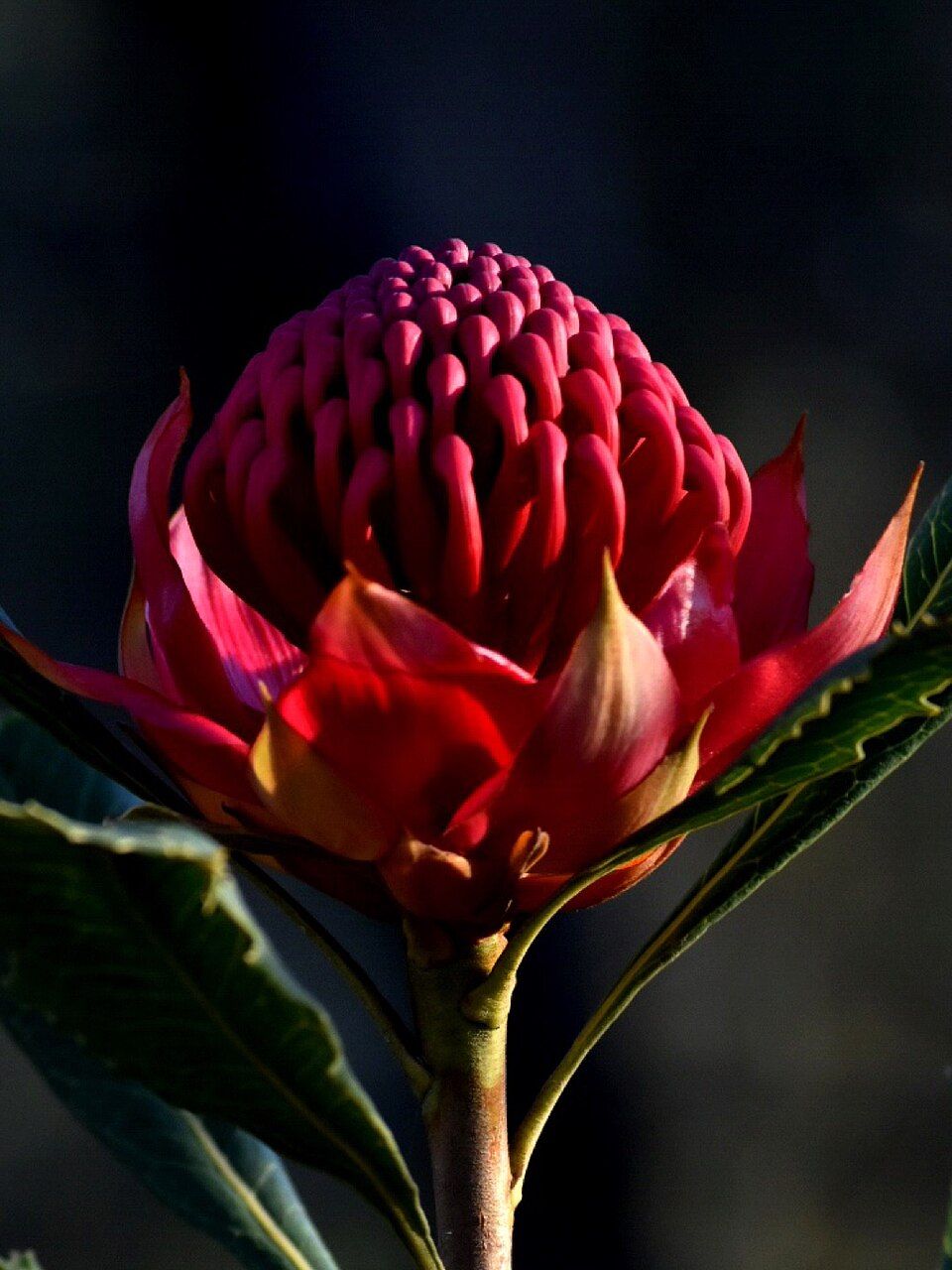
Short answer: most garden waratahs die from wet roots. They want deep, fast-draining, slightly acidic soil that never dries out completely. On heavier shale and clay soils that means planting on a raised mound, not in a hole. Give them sun on the leaves and cool roots, keep big tree roots away, feed only with a low-phosphorus fertiliser, and cut the flower stems back hard after they bloom.
The Australian Native Plants Society says the waratah "causes more problems to gardeners than most other native plants". It's also the plant everyone wants in October, when they flower around Sydney. Here's how to give yours a better chance.
Why they die: five usual causes
1. Wet feet
Waratahs (Telopea speciosissima) do best in deep sand or sandy loam with excellent drainage but a reliable supply of moisture (ANPSA). The classic mistake is digging a big hole in clay and filling it with rich mix. Canberra's national botanic garden (ANBG) warns that water collects in the hole and the plant dies of wet feet. Aim for good drainage to about 45 cm deep.
2. Root rot where sandstone drains poorly
Sandstone isn't a guarantee. Max Hewett, an experienced grower writing in an article the Australian Native Plants Society republished in 2008, saw plants that looked to have Phytophthora root rot in light soils over sandstone, where he suspected the subsoil drained poorly. He found waratahs do best where the main root can go down a metre or more. Plants in a shallow bed on shelf rock needed watering almost every day.
3. Too much shade, or too many roots
Waratahs like sun or light shade, ideally with some shelter from harsh afternoon sun. They won't thrive under the canopy of big established trees (ANPSA; ANBG), and competing tree roots take the water they need.
4. The wrong fertiliser
Use a slow-release, low-phosphorus fertiliser once a year, after flowering in spring (ANPSA; ANBG). Avoid high-phosphorus products.
5. Never pruned
Left alone, a waratah becomes a few long, bare canes with a flower at the top. A hard cut after flowering keeps it productive (see below).
Once they're established in the right spot, waratahs are long-lived shrubs. Most early deaths I see come down to the site: poor drainage, too much phosphorus, too much shade or crowding, or not enough air moving around the plant. Even in a good spot, root diseases can still kill one suddenly, so good drainage matters more than anything. Cut back hard, a healthy waratah regrows from its woody base.
Sandstone, shale and your waratah
North Shore gardens sit on sandy soils from Hawkesbury sandstone, on heavier clay soils from shale, or on a mix. The local plant communities follow the soil. If you're not sure which you have, my free which plant community guide will help.
- Sandy soil over sandstone: closest to where waratahs grow naturally. PlantNET describes them on sandy soils over sandstone, often with clay at depth, in dry eucalypt forest. On my local plant list they appear in Duffys Forest, a community on ironstone-capped sandstone. Plant into the existing soil, check the soil is deep enough for the roots to go down, and water through dry spells.
- Heavy shale or clay soil: build a raised bed or mound. Break up the existing soil first and mix the new soil into it, so there's no hard layer underneath (ANBG). Plant at or above ground level and mound soil around the plant rather than digging a hole (ANPSA). Go easy on the water, because heavy soils waterlog easily. Don't write shale off: Hewett noted that gardeners on richer soils, such as Wahroonga's, had little trouble establishing healthy plants, while sandy gardens often needed extra water and feeding.
Mulch: waratahs like cool roots, but whether a bed needs mulch depends on the site. Where it does, I use coarse mulch only, 50–75 mm deep and kept clear of the stems. My mulch and your soil guide explains why more isn't always better.
Which waratah to buy (Sydney prices, checked 12 Oct 2026)
| Variety | What it is | Price |
|---|---|---|
| 'Shady Lady Red' | A hybrid of the NSW waratah and the Gippsland waratah (T. oreades), sold as hardy and vigorous. About 3 m × 1.5 m, full sun to semi-shade (nursery description). | Sydney's Plant Market: 140 mm $39.95 |
| 'Enchanted Dawn' | A late-flowering hybrid of the NSW and Gippsland waratahs. About 2 m × 1.5 m (Proteaflora, the breeder). | Sydney's Plant Market: 140 mm $39.95 |
| 'Shady Lady White' | The white-flowered form | Sydney's Plant Market: $39.95, sold out when checked |
| Pure Telopea speciosissima | The local species. Seedlings can take about five years to flower (ANBG). | Ask a local native nursery for cutting-grown plants |
Prices and stock change, so check before you go. If you buy from a big-box store, look for the variety name on the label and pick a plant with clean, unmarked leaves. To see which other local plants suit your soil, try the native plant finder.
If your garden backs onto bushland, I'd go for the local species, Telopea speciosissima, rather than a hybrid, so the local genetics don't get mixed up.
Prune hard after flowering
This is the step most people skip. When a flower finishes, or when you pick it, cut the stem back by at least half its length (ANBG). Hewett's ANPSA article says this increases the number of flowering stems the next year. On an old plant that's down to a few bare canes, you can cut them right back to the woody base (the lignotuber) straight after flowering, or spread that over two seasons. In Sydney, waratahs go dormant in late autumn and start new growth from about early August.
Picking flowers for a vase counts as pruning. Cut long stems.
Water: steady, not soggy
- Water deeply in hot or dry spells, and don't let the soil dry out completely (ANBG).
- Water well once flowering starts. Stress at that time can burn the bracts (ANPSA).
- On heavy soils, let the surface dry a little between waterings.
Planning a native garden
Sources
- Australian Native Plants Society, Telopea speciosissima and cultivars: https://anpsa.org.au/plant_profiles/telopea-speciosissima-and-cultivars/ (not proven easy under normal garden conditions; best plants in deep sand or sandy loam with excellent drainage but assured moisture; sunny or lightly shaded, not heavy shade or within the canopy of large trees; slow-release low-phosphorus fertiliser after flowering; regenerates from a lignotuber; tolerant of at least moderate frost)
- Australian National Botanic Gardens, Growing Waratahs: https://anbg.gov.au/telopea/index.html (friable soil; don't dig a big hole and fill it with good mix, water collects and causes wet feet; drainage to 45 cm; raised bed or mound, breaking up existing soil; never let soil dry out completely; over-watering in heavy soils causes waterlogging; semi-shade or shade from afternoon sun; good air circulation; cut canes back by at least half after flowering; low-phosphorus fertiliser once a year)
- ANBG, Telopea speciosissima (2011): https://anbg.gov.au/gnp/interns-2011/telopea-speciosissima.html (flowers September–October in the Sydney region; generally to about 3 m; seedlings take about five years to flower)
- ANPSA (Australian Plants Online, Nov 2008), Growing the Sydney Waratah: https://anpsa.org.au/APOL2008/nov08-2.html (roots cool, foliage in sun; plants with apparent Phytophthora in light soils over sandstone with poor subsoil drainage; cutting flower stems to at least half increases flowering stems next year; old bare canes can be cut to the lignotuber, possibly over two seasons; in Sydney dormant in late autumn, new growth from early August)
- ANPSA (Australian Plants Online, June 2004), Short Cuts: https://anpsa.org.au/APOL34/jun04-14.html (waratah causes more problems to gardeners than most other native plants; plant at or above ground and mound rather than dig a hole; water well once flowering starts; lack of root competition helps)
- Northcote Nursery, Telopea 'Shady Lady' Red: https://northcotenursery.com.au/products/telopea-shady-lady-red (T. speciosissima x oreades; hardy and vigorous hybrid; 3 m x 1.5 m; full sun/semi-shade; well-drained acidic soil). Used for plant description only, not price.
- RF Horticulture native plant list and Which plant community guide (native/native-plants.csv, /guides/which-plant-community/): Blue Gum High Forest and STIF on shale-influenced soils, sandstone communities on sand; T. speciosissima in Duffys Forest community, lateritic/ironstone-mantled sandstone soils, to 3 m (PlantNET)
- Prices: Sydney's Plant Market 'Shady Lady Red' https://sydneyplantmarket.com.au/products/telopea-shady-lady-red ($39.95, 140 mm); 'Enchanted Dawn' https://sydneyplantmarket.com.au/products/telopea-enchanted-dawn ($39.95, 140 mm); 'Shady Lady White' https://sydneyplantmarket.com.au/products/telopea-shady-lady-white ($39.95, sold out). Checked 12 Oct 2026.
- PlantNET habitat for Telopea speciosissima, as recorded in native/native-plants.csv: 'Grows on sandy soils with brown or yellow clay at depth over sandstone, in dry sclerophyll forest' https://plantnet.rbgsyd.nsw.gov.au/cgi-bin/NSWfl.pl?page=nswfl&lvl=sp&name=Telopea~speciosissima
- Proteaflora (breeder), Enchanted Dawn: https://www.proteaflora.com.au/products/proteaflora-plants-telopea-enchanted-dawn (Telopea speciosissima x oreades; late-flowering; H 2.0 m x W 1.5 m; avoid high-phosphorus fertilisers). Checked 12 Oct 2026.